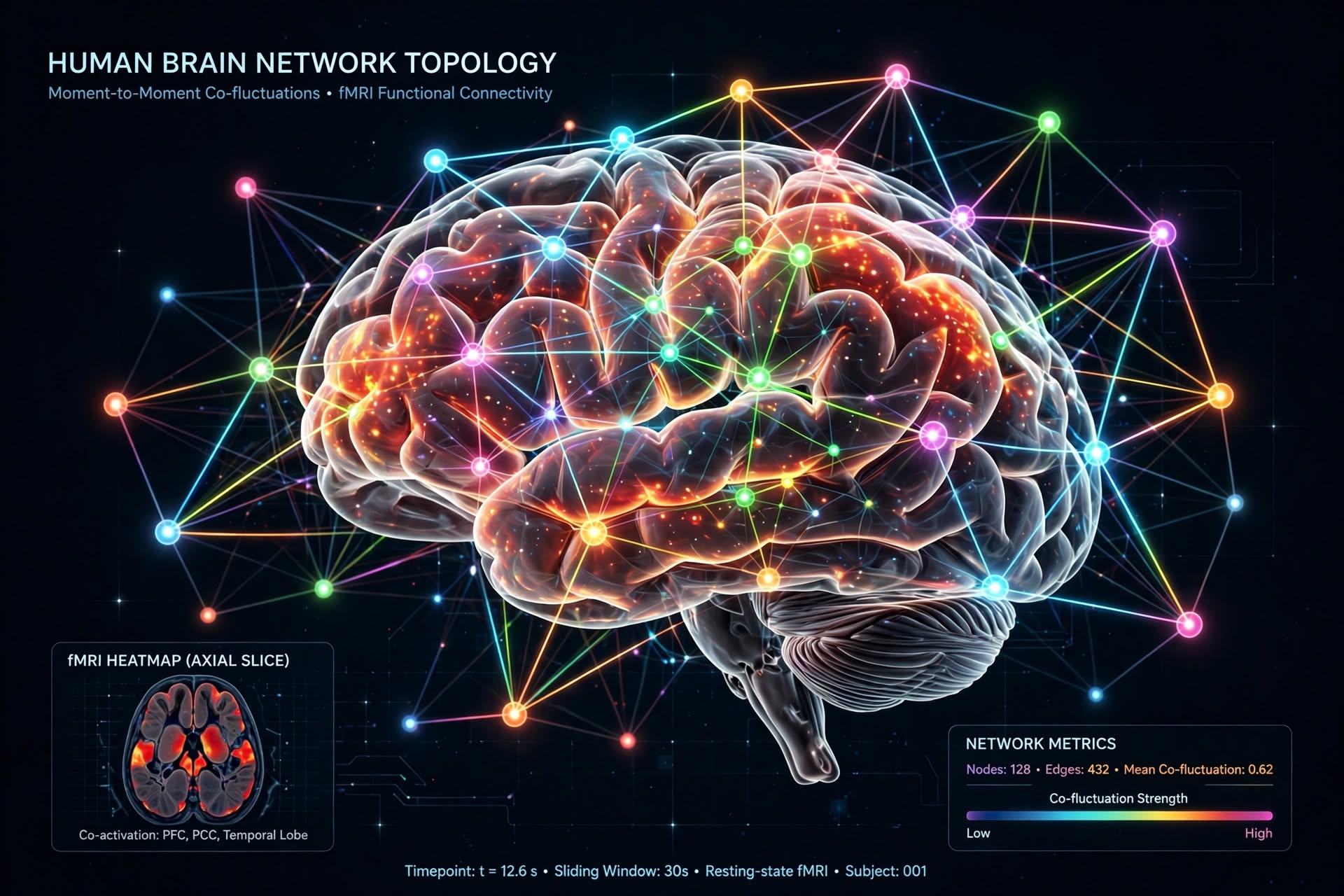
Brain Co Fluctuations Reveal Task States And Personality Links
A new brain study suggests that how brain regions fluctuate together moment by moment may be more revealing than average activity alone. Researchers compared three ways of describing functional MRI data, including regional activation, pairwise co fluctuations and higher order triplet co fluctuations. They used a topological method called Mapper to map the shape of brain dynamics across task and resting state scans from the Human Connectome Project. Maps built from pairwise co fluctuations separated different task conditions more clearly than maps built from activation alone or from triplet patterns. The pattern was driven by strong high amplitude events and reflected coordinated structure beyond simple up or down activity. Across all maps, higher modularity was modestly linked to higher conscientiousness and lower internalising and externalising symptoms. The work offers a new framework for linking large scale brain coordination to cognition, personality and mental health.