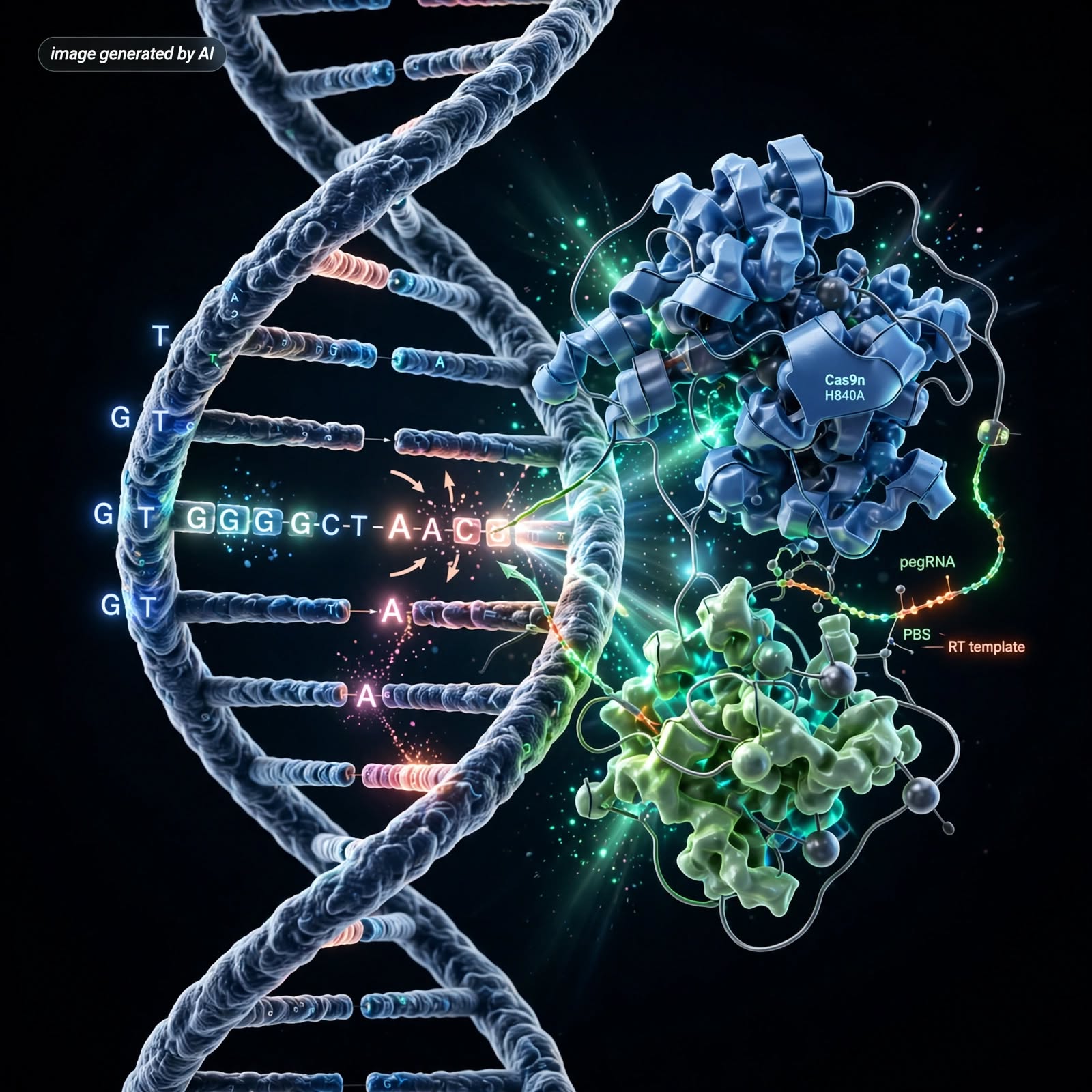
Prime Editing Advances Toward Programmable Genome Rewriting
Prime editing is moving closer to becoming a programmable way to rewrite genomes with high precision. The method combines a Cas9 nickase with reverse transcriptase and a prime editing guide RNA that carries the new genetic instructions. Unlike older tools it can install substitutions insertions and deletions without cutting both DNA strands or needing separate donor DNA. A new review looks at how flap competition DNA repair and guide design shape success and where engineering can improve accuracy. Researchers say the approach is promising for correcting disease mutations that are hard to fix with other editors. Early work in cells and animals shows that careful guide design can raise efficiency and lower unwanted changes. The team says more work is needed on delivery safety and long term effects before wider clinical use.